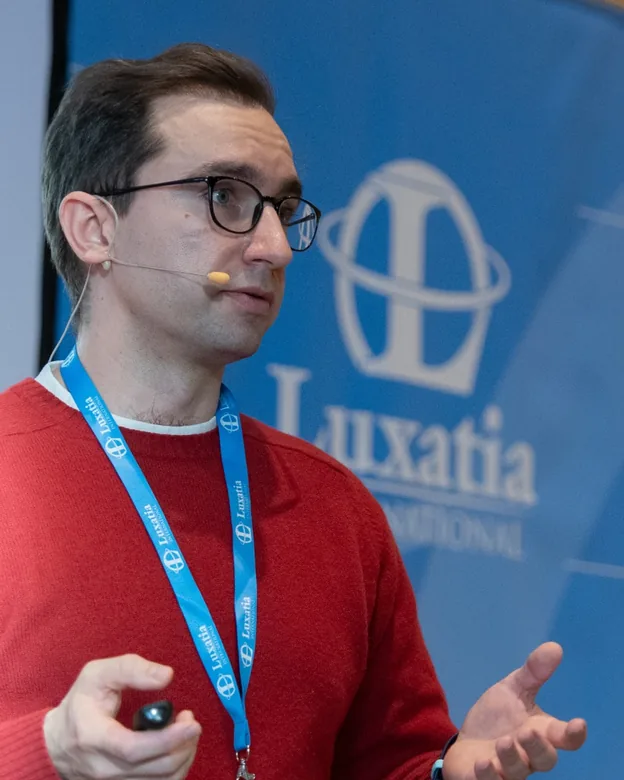
I’m Slava Dubrov—formally, Dr. Viacheslav Dubrov*—a Staff AI Systems Engineer working across agent systems, evaluation, AI security, retrieval, and production infrastructure. I have worked on machine learning since 2011: diagnostics research for power equipment first, then forecasting, recommendations, fraud detection, retrieval, and AI agents in industry.
I usually own the whole path: agreeing with the people who will use a system on what it must do, then building, evaluating, shipping, and running it. These days I’m a Staff Machine Learning Engineer at octonomy AI, working on production AI and software systems. Before that, at HubSpot, I led work on the Context Layer for retrieval, grounding, and memory infrastructure, then worked on Agent Execution across LLM deployment, fine-tuning, evaluation, safety, and runtime. The connecting thread is what happens after a promising model output meets a real system.
I have worked on whether AI systems can be trusted since before LLM assistants. At OLX I built and ran an internal course on explainable AI, and at Wayfair and HubSpot I ran Trustworthy AI workshops on explainability, fairness, and robustness. Agents raise the same questions with higher stakes: what a system is allowed to do, how it can be attacked, and whether an evaluation shows what it claims. I write about agent security and agent evaluation, and at octonomy AI I have started red-teaming our agents for security weaknesses.
My Recursive Harness Engineering series explores how to build a harness, evaluate changes independently, and automate the search for improvements. The early chapters establish the fundamentals before attempting recursion. A small memory-tool experiment shows a fixed proposer using test feedback to choose its next change; later experiments will investigate whether accumulated experience helps on new tasks. People define the objectives, allowed changes, budgets, and criteria for adopting a result. Evaluators and adoption authority remain independent from the improver.
Career
My work has moved from diagnostics research to ranking, fraud detection, retrieval infrastructure, and production agents.
2026–present
octonomy AI
Staff Machine Learning Engineer
Production AI systems at an agentic-AI startup.
2024–2026
HubSpot
Senior Software Engineer II, then Tech Lead ML II
Embeddings and forecasting for AI Signals, the Embedding Hub and Context Layer for AI agents, then Agent Execution.
2021–2024
Wayfair
Senior Machine Learning Scientist
Fraud and scam detection on GCP. I built and led systems associated with about $4M in annual savings.
2018–2021
OLX Group (Prosus)
Data Scientist
Recommendation and search ranking at marketplace scale.
2017–2018
Zalando
Research Engineer
Demand forecasting for logistics, with Spark pipelines on AWS.
2015–2017
Moscow and Berlin
Machine learning for network-security monitoring, customer analytics for a national telecom operator, and NLP for email prioritization at a Berlin SaaS startup.
2011–2015
Platov South-Russian State Polytechnic University
Doctoral research on machine-learning diagnostics for high-voltage equipment.
From problem to production
- Recommendations at OLX, 2019–2020. I led an item2vec recommender from applied research to production, starting with OLX Poland.
- Fraud detection at Wayfair, 2021–2024. Twelve days after joining, I had a proof of concept and a production merge request in progress. I then owned one of the team’s production fraud models, including its refactoring and roadmap, and built self-supervised session embeddings deployed through Vertex AI Pipelines next to the existing models.
- Embedding Hub at HubSpot, 2024–2026. I built the Embedding Hub, a shared vector service on Qdrant, and coordinated it across three teams through an RFC. It was the core of the Context Layer I led for HubSpot’s AI agents.
Public evidence
- At World Agentic AI Summit Berlin 2026, I presented “Engineering the Agentic Stack”: a production architecture covering the cognitive engine, memory, tools, security, and the runtime around them.
- Edge of Context holds the long-form engineering record, including the six-part Engineering the Agentic Stack series. I build and run the site myself, including the pipeline that translates it into seven languages.
- Recursive Harness Engineering connects harness design, evaluation, and improvement through runnable memory-tool and support-assistant experiments.
- Labs collects reproducible artifacts that can be run locally.
Engineering principles
- Decide how success will be measured before choosing a model.
- Make behavior observable before making it autonomous.
- Prefer environment state and outcomes over plausible final answers.
- Make each added harness component earn its cost through ablation.
- Keep evaluators, security policy, and promotion authority independent from the optimizer.
- Preserve failed experiments as evidence.
- Use the cheapest repair layer that solves the real failure.
Research, teaching, and certifications
I hold a Kandidat of Technical Sciences degree (Russian doctoral degree, PhD-equivalent) from Southern Federal University. My thesis developed a two-stage method for identifying the condition of high-voltage circuit breakers: fuzzy and statistical rules first, then neural networks tuned by a genetic algorithm. Before that, I earned an engineering degree with honours in information and measurement technology.
- Fellowships and grants: two DAAD Leonhard Euler scholarships for research stays at TU Braunschweig (2011) and TU Dortmund (2013), a six-month DAAD Lomonosov fellowship in mechatronics at TU Ilmenau (2013–2014), the Russian President’s scholarship for young scientists (2013–2014), and a UMNIK youth innovation grant as project leader.
- Publications: 25 research publications, a patent on diagnosing electrical switching equipment, and a co-authored benchmark of job-recommendation methods tested online on OLX Jobs.
- Teaching and mentoring: a Spark and Spark MLlib course at the Higher School of Economics in Moscow (2016), two internal courses at OLX, on machine learning and on explainable AI, and workshops on deep learning and trustworthy AI at Wayfair and HubSpot. I have mentored engineers since Zalando, including colleagues who moved into ML and AI engineering roles.
- Certifications earned: AWS Certified Machine Learning – Specialty (2020) and AWS Certified Solutions Architect – Associate (2019); Udacity nanodegrees in machine learning, AI, deep reinforcement learning, AI for trading, and computer vision (2017–2021).
Capabilities
| Capability | Working areas |
|---|---|
| Agent systems | reasoning loops, memory, tool interfaces, runtimes, harnesses, observability |
| Evaluation and assurance | trace-based evaluation, regression suites, red-teaming, guardrails, permissions, explainability, robustness |
| Retrieval and context | semantic and hybrid retrieval, reranking, grounding, context compression |
| Model engineering | fine-tuning, LoRA/QLoRA, serving, quantization, structured generation |
| Applied machine learning | recommendations, search ranking, fraud detection, forecasting, self-supervised embeddings, graph neural networks |
| Product delivery | specifications with users, A/B tests, staged rollouts, model roadmaps |
| Production infrastructure | AWS, GCP, Kubernetes, Spark, batch, streaming, and real-time ML systems |
Elsewhere
Professional background is on LinkedIn. Source and reproducible artifacts are on GitHub. New essays also appear on Substack.
* Kandidat of Technical Sciences (Russian doctoral degree, PhD-equivalent), awarded by Southern Federal University, Rostov-on-Don, 2015.